Tatu Tuominen:
A Near Approach to Immortality
Gallery Katariina is delighted to present the exhibition A Near Approach to Immortality by Tatu Tuominen, running from 13 February to 8 March, 2026. We warmly invite you to the exhibition opening on Thursday, February 12th, from 5 to 7 PM!
NB! Artist meeting at Gallery Katariina on Saturday, February 28th, from 2 PM to 4 PM. Welcome!
Tatu Tuominen’s exhibition leads the viewer into primeval forests that disappeared centuries ago.
Tatu Tuominen’s exhibition A Near Approach to Immortality is a body of work that explores the lost European primeval forest. It is examined through historical documents: Encyclopedic text from classical antiquity and renaissance landscape etchings. The artworks of the exhibition probe what art-historical images reveal about the human relationship with the forest, both in the past and in the present.
An art-historical landscape has often been presented as perfect, static, and complete. In the current ecological situation, however, proposing this kind of landscape seems impossible. The landscape no longer presents itself as pristine or permanent, because human activity has an impact everywhere in the world. This is why the landscape works presented by Tatu Tuominen are in a state of becoming: they are imperfect, in flux, and fragmentary—as is the world around us.
For the exhibition, Tuominen draws primarily on two historical sources: the writings of Roman author and natural historian Pliny the Elder (23–79 CE) and the landscape etchings of the German painter and printmaker Albrecht Altdorfer (1480–1538).
Pliny refers to the Hercynian Forest twice in his work Naturalis Historia. Hercynia is a mythical primeval forest that was situated beyond the borders of the Roman Empire, in the region of western Central Europe. According to Pliny, Hercynia is an impenetrable and otherworldly place. To him it represents untamed nature—a territory that not even Rome could govern. Pliny writes: “the Hercynian Forest, whose gigantic oaks, uninjured by the lapse of ages, and contemporary with the creation of the world, by their near approach to immortality surpass all other marvels known”. It is startling that something which, in its own time, seemed as if it had always existed and would exist forever, has disappeared, and remains only in stories.
Altforfer’s print editions were among the first works to disseminate the concept of landscape across Europe, as they could be reproduced in multiple copies and distributed. This coincided, during the first decades of the 16th century, with the emergence of landscape as an independent subjectmatter in visual art, for the first time without humans and without a religious or mythological subtext.
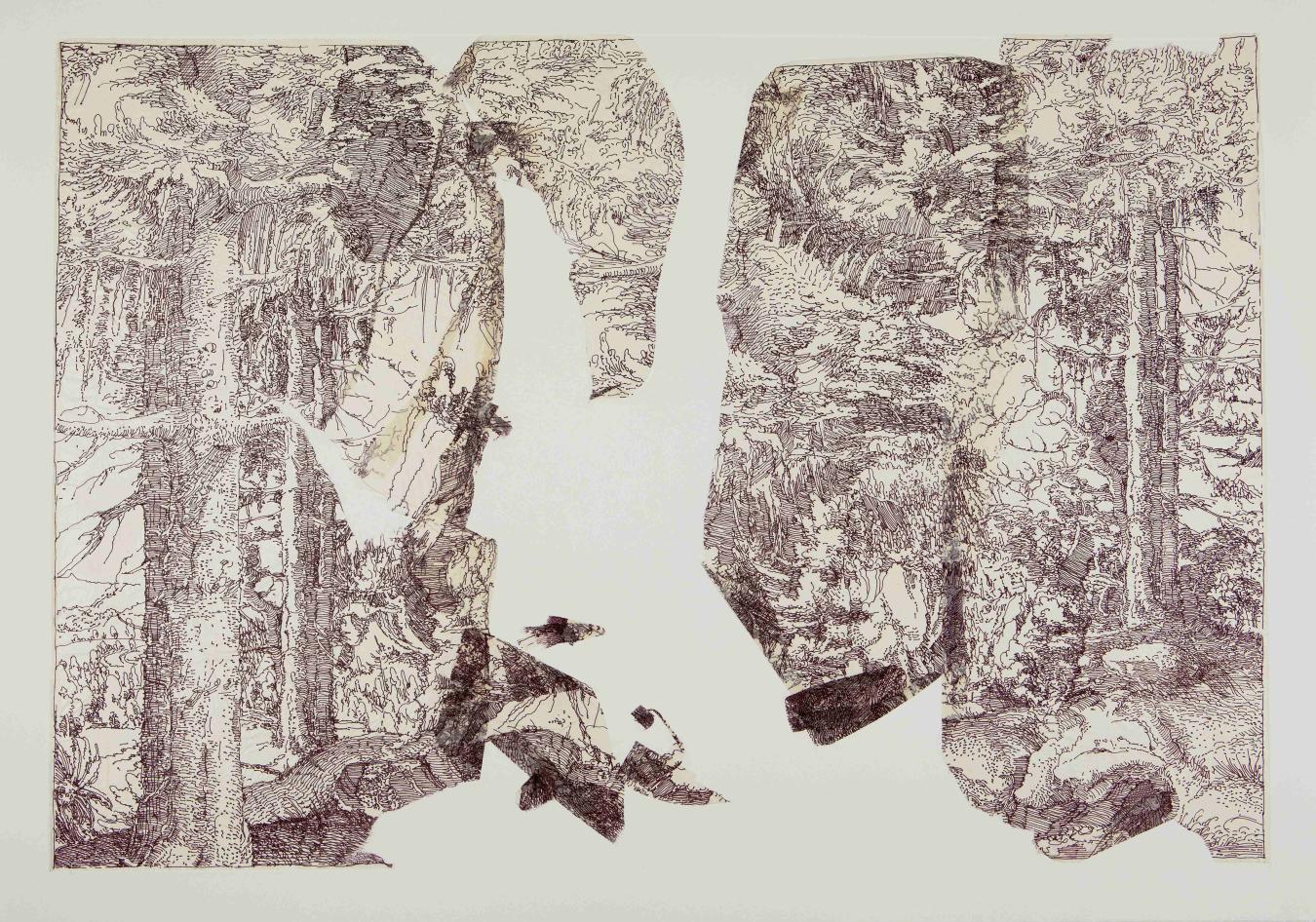
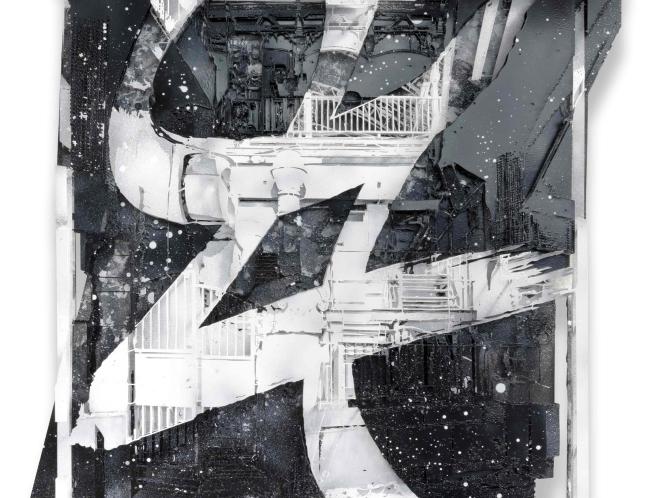
For the series A Near Approach to Immortality (Landscapes), Tuominen creates new landscapes by tracing the lines of Altforfer’s etchings, manipulating them through drawing, cutting and gluing paper. With this series of drawings, Tuominen presents a world that could exist if the human need to clear forests for agriculture and produce timber on an industrial scale had not led to the destruction of almost all old-growth forests.
A Near Approach to Immortality (Hercynian Forest) is a moving image and sound work in which the Hercynian forest emerges as a paper stage set, while the viewer’s gaze slowly moves through the landscape. In the work, the small paper scraps grow to colossal proportions. The soundtrack is composed of sounds produced by the paper itself.
A Near Approach to Immortality (Foliage) is a paper cut-out installation comprised of letters. Tuominen cut out the parts of Pliny’s text that dealt with the Hercynian Forest and created an installation in the gallery–a kind of foliage made up of natural history quotes.
The forest landscapes depicted by Altdorfer and Pliny the Elder have long since disappeared from Central Europe due to deforestation. The artworks in the exhibition engage with this debate by questioning: What is the relationship between historical landscape images and today’s environmental discourse? Could the act of remembering help us imagine a different future for our environment? We can no longer return to the primeval forests that vanished centuries ago, but in this exhibition, one can imagine what it might feel like to walk under their canopy.
The artist’s work and the production of the works have been supported by The Finnish Cultural Foundation, The Arts Promotion Centre Finland and AVEK.
Gallery Katariina
Rikhardinkatu 1, 00130 Helsinki
Tue–Fri 11am–5pm,
Sat–Sun 12–4pm
 Follow us on Instagram